The Boundary Condition
Fraud, Forensics, and the Vanishing Utility of AI Where Legitimate and Malicious Activity Converge
Peter J. Worth Jr., Founder, President & CEO of Athena Security Group | October 2026
Summary:
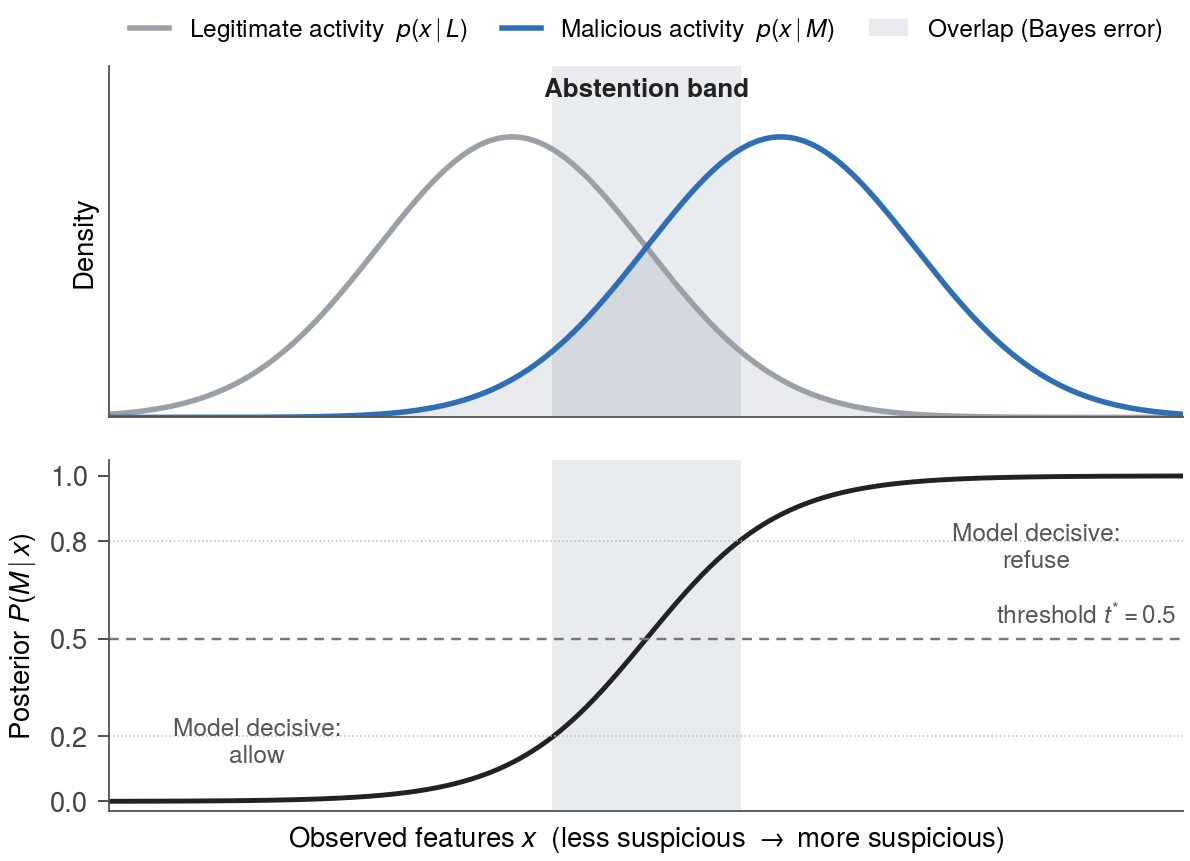
During the July 2026 OpenAI–Hugging Face incident, defenders found that hosted frontier models refused to assist with forensic analysis because the evidence they needed to examine was indistinguishable from offensive material. Payment systems exhibit the same failure at far greater scale: card authorization models routinely decline legitimate customers, at a measured cost that exceeds losses to fraud. This report argues that both phenomena are instances of a single statistical property. Where the class-conditional distributions of malicious and legitimate activity overlap, the Bayes error is irreducible, the posterior collapses toward the prior, and the model’s marginal contribution to the decision approaches zero. Refusal in that region reflects the provider’s cost function, not evidence in the input; it is systematically under-measured because refusals erase their own outcome labels; and adversaries actively migrate into it. Drawing on decision theory, the base-rate literature, and recent over-refusal benchmarks, we show that no increase in model capability recovers a distinction absent from the data, and we propose five design principles, anchored in Chow’s reject option, for routing boundary cases to controls that condition on identity, authorization, provenance, and context.
Get the full paper!